

Application model
View MarkdownEvery piece of the Dagger wiring in a Vertique application has an owner. This page explains who owns each piece: what the launcher does before your code runs, what your own Dagger component and module compose, what code generation produces for you, how starters compose framework capability, and how lifecycle phases order verticle deployment. It uses the REST application generated in Quickstart as its running example.
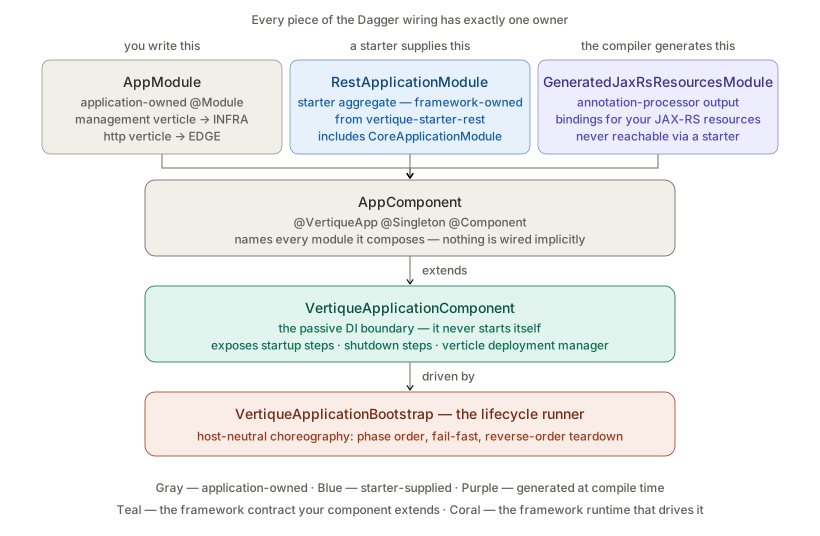
Mental model
Section titled “Mental model”The pieces fit together as follows. Each one is explained in full further down this page, in its own module reference, or on its own corpus page:
- Application component. Every application supplies its own Dagger
@Component. On the supported path it is annotated@VertiqueApp, which generates the component factory a manual registration would otherwise supply. See What your application owns. - Verticles and deployments. Your application contributes
VerticleDeploymententries into a named lifecycle phase, and the framework deploys each phase’s verticles in order. See How lifecycle phases order deployments. - Launcher vs. runner.
vertique-launcher’sVertiqueApplicationis the host-specific entrypoint that builds the realVertxinstance and discovers your component. It hands off to the host-neutral lifecycle runner, which drives the phases. See What the launcher owns and thevertique-applicationmodule reference. - Starters vs. direct modules. A starter composes a fixed set of framework modules behind one class name, and which modules it includes is a release-line compatibility surface. Capability with no starter is named directly as a framework module in your own component. See What starters own and the supported path.
- Code generation. Annotation processors emit Dagger modules, such as
GeneratedJaxRsResourcesModule, from your own annotated classes at compile time, so you do not hand-write their bindings. See What code generation produces. - Configuration. Your Dagger modules read typed configuration parsed from the merged JSON/properties/environment/system-property tree. See Configuration.
- Durable work. Workflows, jobs, and inbox/outbox messaging plug into the same component and lifecycle phases as everything else. They are composed as direct modules rather than through a starter. See Workflows.
- The management plane. Health and readiness live on a management surface separate from the
application edge (port
9090in generated applications). Liveness answers whether the process can run, and readiness answers whether it should receive traffic. See Deployment.
What the launcher owns
Section titled “What the launcher owns”vertique-launcher supplies VertiqueApplication, the framework-owned entrypoint every generated
application runs as its Main-Class. Before your Dagger graph exists, VertiqueApplication
resolves the application’s configuration on a temporary Vert.x instance, builds the real Vertx
instance, discovers your application’s component factory via ServiceLoader, and drives the
deployed application through to shutdown. A bootstrap-configuration failure exits with code 11;
a verticle deploy failure exits with code 15.
Because the REST archetype places @VertiqueApp on AppComponent (below), the generated project
needs no hand-written main class or manifest entry. The annotation is enough to register the
factory the launcher discovers. The generated project depends on both vertique-starter-rest and
vertique-launcher, and mvn -ntp exec:java (the command the quickstart uses to start the
application) runs VertiqueApplication as the Main-Class. Your application code never calls the
launcher directly.
What your application owns
Section titled “What your application owns”Every Vertique application supplies its own Dagger @Component and at least one
application-owned module contributing deployment entries. This is AppComponent from the
generated REST application:
@VertiqueApp@Singleton@Component( modules = { RestApplicationModule.class, AppModule.class, GeneratedJaxRsResourcesModule.class })interface AppComponent extends VertiqueApplicationComponent {}AppComponent extends VertiqueApplicationComponent, the passive DI boundary the framework’s
lifecycle runner drives. It exposes only the application’s startup steps, its shutdown steps, and
its verticle deployment manager. The component does not start itself.
AppModule, in the same generated project, is the application-owned module that makes this
component serve traffic (package and import lines omitted for focus):
@Moduleclass AppModule {
    @Provides    @IntoSet    static VerticleDeployment managementVerticle(Provider<ManagementVerticle> provider) {        return VerticleDeployment.of("management", provider::get, LifecyclePhase.INFRA);    }
    @Provides    @IntoSet    static VerticleDeployment httpVerticle(Provider<HttpVerticle> provider) {        return VerticleDeployment.of("http", provider::get, LifecyclePhase.EDGE);    }}
It contributes two @Provides @IntoSet bindings: a management verticle deployed at the
INFRA lifecycle phase, and an http verticle deployed at the EDGE lifecycle phase.
RestApplicationModule and GeneratedJaxRsResourcesModule contribute no deployment entries of
their own. Without AppModule, this component builds a complete graph but serves neither
surface.
What code generation produces
Section titled “What code generation produces”GeneratedJaxRsResourcesModule, named directly in AppComponent above, is annotation-processor
output. It is generated from the project’s JAX-RS resource classes (HelloResource in the
quickstart) and carries their Dagger bindings. Generated modules like this one are never
reachable from a framework starter aggregate. They must be listed in your @Component explicitly,
as AppComponent does here.
What starters own
Section titled “What starters own”RestApplicationModule, from vertique-starter-rest, is the framework aggregate AppComponent
names for a REST-serving application. Starter aggregate membership (which modules a named
starter includes, and only those) is a release-line compatibility surface. Consumers may rely on
it, and a change to it is treated as compatibility-affecting. Vertique publishes four such
aggregates:
| Starter | Aggregate | When to use it |
|---|---|---|
vertique-starter-core |
CoreApplicationModule |
Lifecycle foundation only: no HTTP, no event bus, no persistence |
vertique-starter-rest |
RestApplicationModule |
Serves an HTTP API through JAX-RS resources; already includes CoreApplicationModule |
vertique-starter-services |
ServicesApplicationModule |
Typed service-contract execution; already includes CoreApplicationModule |
vertique-starter-postgresql |
PostgresqlPersistenceModule |
PostgreSQL pooling and Flyway migration wiring; composed alongside an application starter, never in place of one |
An application names only the starters it needs, and never repeats a module a starter already
reaches transitively. vertique-starter-postgresql is an independent capability and is not an
application foundation. It supplies no Vertx binding, no config parser, and no lifecycle
runner on its own, so it is always paired with vertique-starter-core, -rest, or -services.
How lifecycle phases order deployments
Section titled “How lifecycle phases order deployments”The framework’s lifecycle runner drives eight ordered phases: CONFIGURE, VALIDATE, MIGRATE,
BOOTSTRAP, INFRA, SERVICES, EDGE, and AFTER_START. For each phase, in that order, it
runs the phase’s contributed startup steps. For the four phases that carry deployments
(BOOTSTRAP, INFRA, SERVICES, EDGE), it then deploys that phase’s verticles.
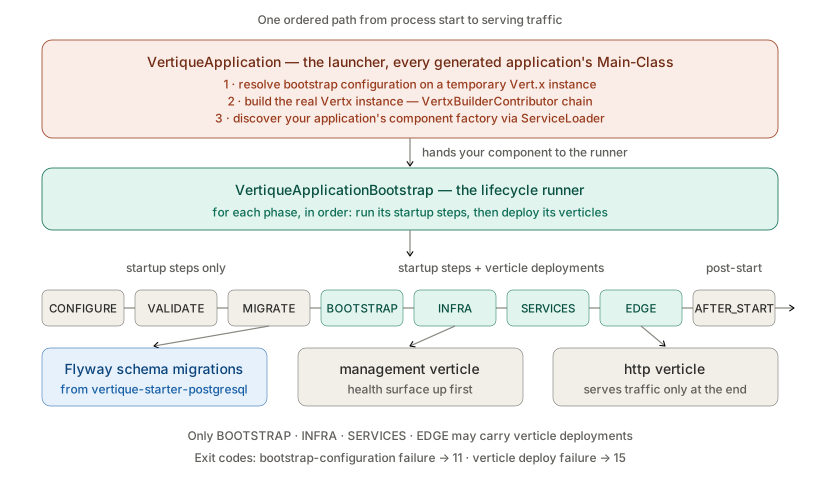
In the generated REST application, AppModule’s two deployment entries land in two different
phases: the management verticle deploys at INFRA, before the http verticle deploys at
EDGE. The management (health) surface is therefore up before the HTTP surface starts serving
traffic. Adding the PostgreSQL starter to the same component inserts a MIGRATE-phase startup
step that runs schema migrations before any of these verticle phases deploy.
Learn more
Section titled “Learn more”vertique-launchermodule reference: the startup sequence, exit codes, and theVertxBuilderContributorSPI.vertique-applicationmodule reference: theVertiqueApplicationComponentcontract, the lifecycle runner, and every contributed startup and shutdown step.vertique-starter-coremodule referencevertique-starter-restmodule referencevertique-starter-servicesmodule referencevertique-starter-postgresqlmodule reference- Configuration: how the config tree these components inject gets built.
- What is Vertique?
Continue reading
Section titled “Continue reading”- Previous: Agent skills
- Next: Dependency injection